I went back recently and pulled together a bunch of BoP schedule I could find in my own archive.
What surprised me, looking at them all together, was not the diversity but the consistency. The order of works is essentially the same everywhere. The durations cluster in narrow bands once you account for project size.
And the milestone payments, when they are properly defined, follow a recognisable pattern.
Standard order of works
If you stack the schedules of a 5-WTG project, a 16-WTG project, a 30-WTG project and a 57-WTG project on top of each other, the order of activities is usually identical. The size of the project changes the duration of each block, not the sequence. Here is what recurs.
Engineering and long-lead equipment start at Notice to Proceed, or (often) even before.
You will need several things in parallel: the topographic survey on site, a good geotechnical survey, the detailed civil engineering (foundation drawings, road geometry, drainage), and the procurement of the long-lead equipment.
The single longest item on every BoP critical path I have ever reviewed is usually the power transformer. From order placement to delivery on site you are looking at eight months to more than one year, sometimes more. If you do not place that order in the first weeks after NTP (or even before, with a “Limited Notice To Proceed”, the entire commissioning date moves out by however long you delay.
Site mobilisation: Laydown yard, site offices, fuel storage, sometimes a concrete batch plant if the site is remote. This is the “Site Establishment” milestone in most contracts. It is not glamorous, but it is the gating activity for everything physical that follows.
External access road modifications, if needed. Many wind farm sites cannot be reached by the standard truck-and-trailer combinations carrying nacelles and blades without first widening corners, reinforcing bridges, or trimming overhead obstructions. This work usually starts as soon as the permits arrive. The scope can range from a few days of trimming to several months if you need bridge reinforcement or something really big.
Internal access roads and crane pads. This is the “Site Access Works” milestone in some contracts and it typically runs three to four months for a small to medium size project. Internal roads come first because they enable everything else, then crane pads (one per turbine plus auxiliary crane areas, if needed).
Foundations. Each individual WTG foundation takes roughly four to six weeks from excavation to grouting (excavation, blinding, anchor cage installation, rebar, pour, cure). On a real project the foundations are built in parallel, so the total foundation phase for a fifteen-turbine farm is closer to three or four months than to fifteen times six weeks.
MV cabling and trenches. Trenches are excavated, sand bed laid, MV and fibre-optic cables pulled, sand bed and warning tape installed, trenches backfilled and compacted. This work runs in parallel with foundations and is rarely on the critical path for an onshore project.
Substation civil works. Control building foundation and superstructure, switchyard slab, oil containment, cable troughs, perimeter fence. Maybe around six months depending on the size of the substation.
Substation electromechanical assembly. This phase cannot start until the main transformer arrives on site, which is the moment the long-lead equipment cycle finally pays off (or punishes you).
Transmission line, when it is in scope. A separate parallel track with its own engineering, equipment, civil works (towers, foundations), assembly (cable stringing) and commissioning. Adding a transmission line to the BoP scope typically extends total duration by several months and introduces an extra licensing sequence.
Energisation, testing, commissioning, taking over. The final few months. SCADA installation, MV circuit energisation, substation commissioning, “ready for grid connection” milestone, then formal Taking Over.
The order is the same everywhere because the work itself imposes it. You cannot start the foundation pour before the excavation. You cannot pull cables before the trench is open. You cannot energise the substation before the transformer is installed. The schedule is, in this sense, a physical constraint dressed up as a planning document.
Plausible durations
If you need a rough order of magnitude it could be something like this:
| Scope | Total NTP to Taking Over |
|---|---|
| 5 WTGs, no substation, no transmission line | 7 to 12 months |
| 20 WTGs, substation, no transmission line | 16+ months |
| 50 or more WTGs, with substation(s) and overhead line | 24+ months |
The single biggest determinant of total duration is often not the number of turbines, it is whether one or more substation and a transmission line is in BoP scope.
The second biggest determinant is the OEM delivery date for the first WTG. Whatever date the OEM commits to as the first nacelle on site, that is the day before which (almost) everything civil and electrical leading to that turbine must be ready.
Engineering durations are routinely under-estimated: detailed civil engineering for a wind farm is not a four-week activity.
Winter and rainy seasons are often invisible on the chart: many of the schedules showed no shaded weather window even on projects in places where everyone on the team knew earthworks would be impossible for two months a year.
OEM activities get omitted: crane mobilisation, WTG delivery, technician availability for commissioning are not BoP scope, but if you do not have them on your schedule with realistic dates, you cannot calculate the float on your own activities.
Permits are often optimistic: construction permit, environmental permit, archaeological clearance, road occupancy, electrical interconnection, every one of these has a queue at the relevant authority.
Milestone payments
Sitting beside every BoP schedule is its commercial twin, the milestone payment schedule. This is the document that defines, for each milestone of the works, what percentage of the contract value gets invoiced and what percentage flows down to the subcontractor.
Milestones tied to vague descriptions are milestones that get fought over at invoice time. The cleanest payment schedules I have seen tie each percentage to a specific, independently verifiable deliverable: a topographic survey for road completion, a plate-load test for crane pads, the seven-day strength test for foundation concrete, a cable test for MV completion.
When the question of whether a milestone is achieved has an objective answer, it gets paid quickly and the project keeps moving.
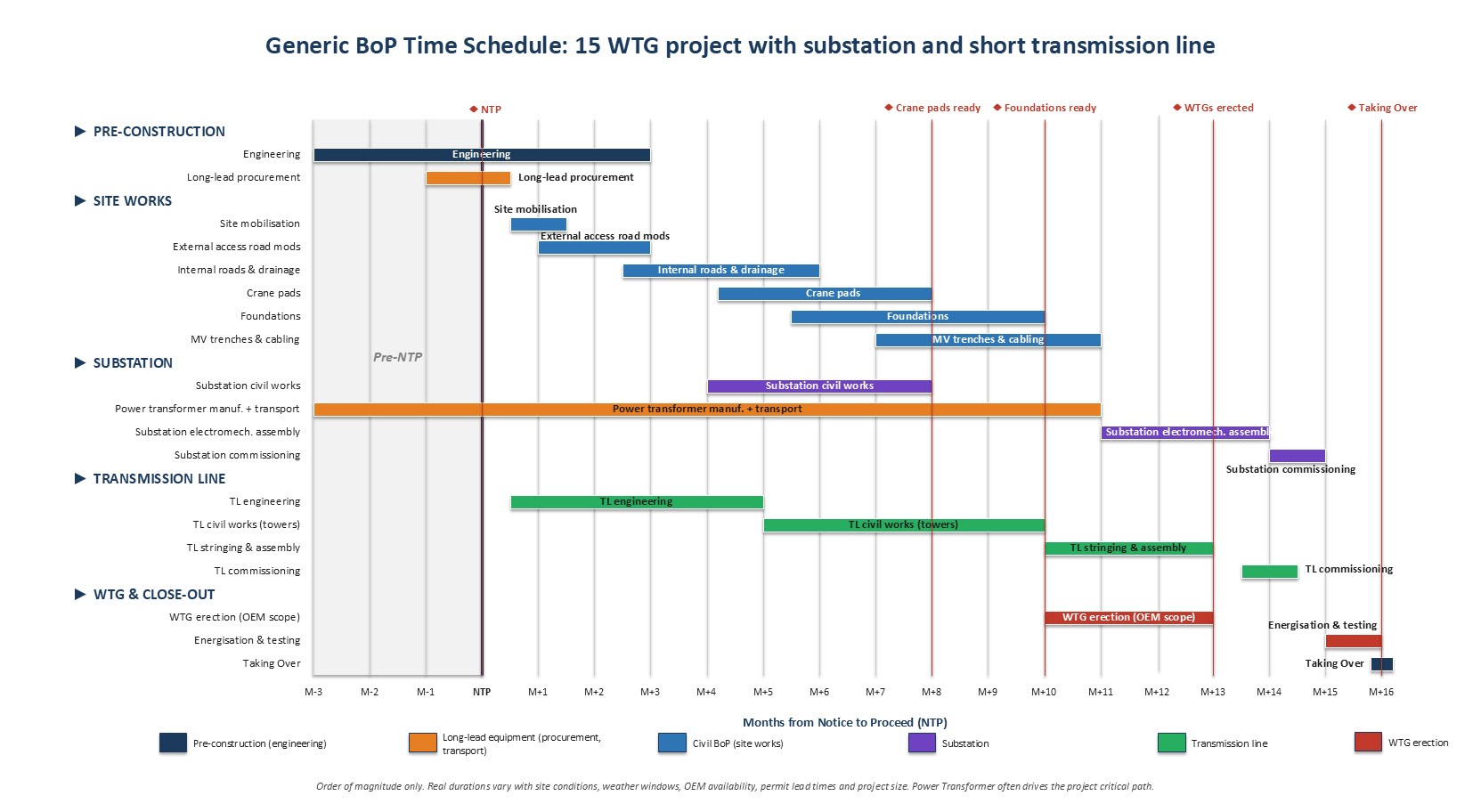
A generic, reference Gantt
To make the durations and the order of works concrete, I put together a generic Gantt chart for a typical mid-size project (about 15 turbines, with substation, with a short transmission line). It is not a template (every project is different and a real schedule needs site-specific durations), but it captures the order-of-magnitude proportions you should expect.
The chart makes three things visible at a glance. First, the power transformer track on the substation row define the critical path, even though it sits mostly outside the site activities. Second, the WTG delivery date sits about two-thirds of the way through the programme, with a buffer of roads and crane pads completed before it. Third, the milestone payments for both Civil BoP and Electrical BoP are usually spread unevenly.
What a good BoP schedule looks like
They have at least several weeks of float, for instance before the first crane mobilisation. They tie the milestone payment schedule to schedule activities.
Everything else is detail. The order of foundation pours, the exact week the cable pulling starts, the precise length of the road acceptance procedure, these can shift, and they will. What cannot shift is the discipline of having a schedule that reflects how the work actually happens, signed by the people who will do it, and updated honestly when reality intervenes.
Leave a Reply