If you see the Environmental Impact Assessment (EIA) as a box-ticking exercise sitting between the developer and the permit, something written by environmental consultants, approved by authorities, filed away and forgotten – you should think again.
That is a mistake.
Every EIA contains a list of commitments, promises the developer makes to the community and to the authorities about how the wind farm will be built, operated, and eventually dismantled.
And those commitments, once the permit is granted, become (legally) binding constraints on the engineering team that actually has to build the thing.
In this article we see how a line in an report (“minimise impact on breeding birds”) becomes a real construction-site rule (“no earthworks between April 1 and July 15 in these sectors”).
It is based on a handful of real EIA documents from Italy, Spain, Uruguay, Chile, and Poland that span roughly fifteen years of wind farm permitting.
The examples are specific, but the pattern repeats everywhere.
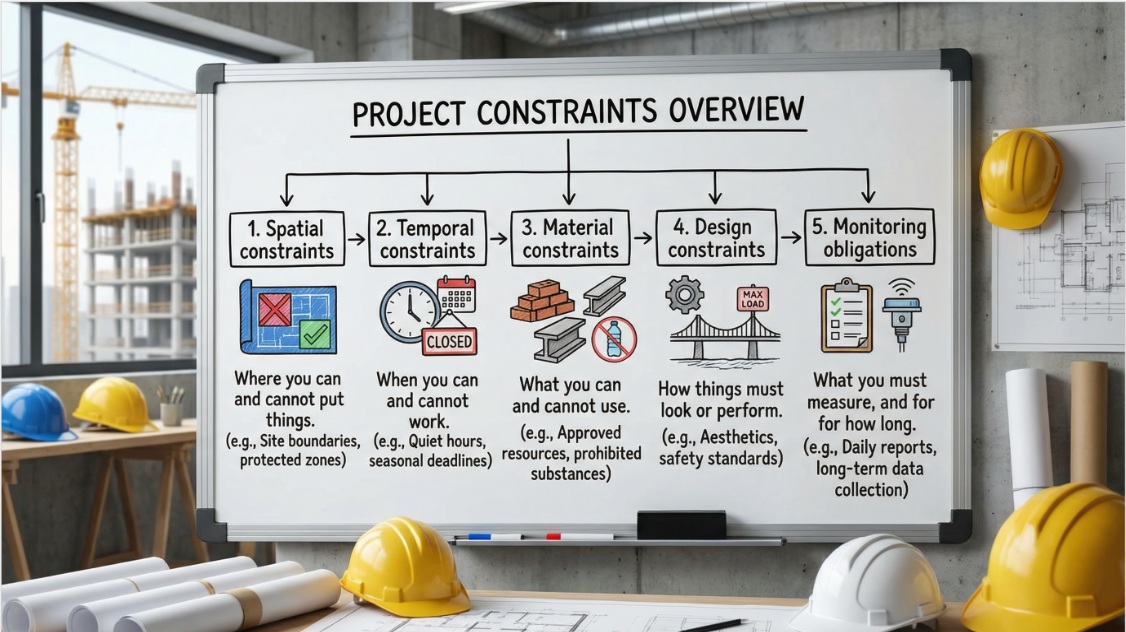
Five categories of constraints
If you read enough EIAs, you start to see that mitigation measure usually fall into one of five buckets. Each bucket lands somewhere specific in the BoP workflow.
1. Spatial constraints — where you can and cannot put things.
2. Temporal constraints — when you can and cannot work.
3. Material constraints — what you can and cannot use.
4. Design constraints — how things must look or perform.
5. Monitoring obligations — what you must measure, and for how long.
Let me walk through each with examples from real projects.
Spatial constraints
These are the most visible. The EIA fixes the turbine positions, the access roads layout, theoverhead line alignment, and the substation footprint — and then it says: everything else is off-limits.
In a project in Italy the route selection was driven by environmental considerations, and the developer committed to access the site from the north (instead of a possible southern alternative), because the southern track “is in some points very deteriorated.” That sounds like a logistics choice, but once written in the EIA it becomes a constraint: the BoP contractor cannot decide, six months later, to shift the access to the south because a subcontractor prefers it, or to use both roads – usually the smart thing to do.
The same EIA fixes the minimum road width (5 m). This could be enough, but sometimes you want to have more (6+ meters).
Another spatial constraint that shows up repeatedly: buffer distances from houses, watercourses, and sensitive areas.
In EIA terms, these constraints translate into a “no-go” map that the BoP engineer has to respect throughout construction.
Temporal constraints
Temporal constraints are the ones that could surprise project managers the most, because they don’t appear on the CAD drawings (but hopefully they appear in the construction schedule – otherwise you have a problem).
The typical case is seasonal restrictions tied to breeding birds, bat activity, or animals migration.
The EIA identifies sensitive species in the area, commits to avoiding disturbance during their reproductive period, and the permit condition then lists specific dates during which earthworks, blasting, or heavy traffic are not allowed in certain sectors of the site.
In Europe, this typically means no earthworks from mid-March to mid-July in ground-nesting bird areas. Some reproductive windows that can reach five or six months.
The practical effect: your construction schedule has (or should have) non-workable windows baked in from day one. If your project has three months of heavy earthworks and a five-month breeding exclusion, you have already lost flexibility. Your schedule either starts in August or finishes in March — anything else gets blocked.
There is also a category of daily temporal constraints. Usually heavy transport are requested to move outside the peak hours. That sounds trivial, but multiply it across many turbines and you are adding complexity.
Material constraints
An example is the request to use “lithic aggregate, non-bituminous material” for road widening on the ridge. That means no asphalt — stabilised gravel only. Fair enough.
Another project must use a lead-free paint on the towers. That is a paint-specification item. Not my (BoP) problem, but someone in Towers should take care of it.
Often you have to work with topsoil stockpiling and reinstatement: the topsoil stripped during construction of the crane pads is to be stored separately and respread on the pad after commissioning, “to favour re-establishment of grass and shrub cover.”
That is actuallt a double constraint — it forces the contractor to have a topsoil stockpile area on site (more land take, temporarily) and to come back at the end for reinstatement (more cost, more mobilisation).
Design constraints
These are the constraints that shape how things look and how they behave.
Turbine colour and marking. EIAs typically specify the tower colour — grey (seen in LATAM, to blend with the horizon), off-white (most European projects). More interestingly, several EIAs propose blade contrast measures to reduce bird collision: black paint on one of the three blades, UV-reflective paint, or coloured bands across the blade chord. Monterenzio mentions all three as options. Fifteen years later, black-blade trials are being conducted across Europe with promising results.
Aviation lighting. Every jurisdiction has its own aviation authority manual, and the EIA binds the developer to follow it. This shows up later as a procurement item (specific beacon models), a cabling item (power supply and control), and an operational item (scheduled maintenance).
Acoustic performance. One of the projects had a 70 dB(A) daytime and 60 dB(A) nighttime differential limits. Those limits, combined with the WTG sound power spectrum and the distance to receptors, drive the turbine layout. If a turbine position cannot meet the nighttime limit, it either moves, gets de-rated in a noise-reduced operational mode, or gets curtailed at night. The EIA makes this commitment visible; the BoP team then has to live with it.
Underground cabling. Usually they will ask you to bury all the internal MV cabling specifically to avoid raptor electrocution and collision.
Apparently “electrocution and collision with overhead lines are the two most frequent causes of mortality” for raptors – or this is what one EIA says.
That commitment makes the choice of buried vs. overhead MV a non-decision — you have to go underground — which in turn affects cable sizing, trench design, and thermal analysis.
Monitoring obligations
The last category is the one that keeps costing money after the construction team has demobilised.
A classic is to have a bird monitoring plan lasting at least two years, covering all four seasons, with periodic surveys of turbine-struck birds (“muestreos periódicos de los animales muertos”). That is a dedicated ecologist, walking the site on a published schedule, for two full years.
Other projects request a broader monitoring programme covering avifauna and chiropterofauna, with a control area off-site that has the same characteristics, and with carcass-persistence tests (re-positioning found carcasses to measure how long they last before scavengers take them). That level of protocol means a real biology contract, not a box-tick.
Another classic request is the noise monitoring at receptors during operation, and to a post-commissioning landscape monitoring programme for one or two years to verify that vegetation restoration has worked.
The BoP implication: noone.
This is not your baby, these are operational expenditures that the developer has committed to, in writing, before the project was even built.
They should appear in theproject budget, and someone in the operating team needs to be responsible for delivering them.
Forgetting them creates a compliance gap that is very uncomfortable to explain if an inspector shows up – but again, this is not your problem.
Here’s what I recommend
Read the EIA at kick-off.
Living with this constraints is your problem. And that is where things can go wrong: if the EIA sits in a folder, and the BoP team ignore it, sooner or later the project could be stopped or delayed.
If you are lucky you will find a summary table that lists impacts, mitigation measures, and monitoring obligations in a matrix. That table is the cheat sheet. Print it, staple it to the site office wall, and refer back to it when scheduling earthworks, selecting materials, or approving changes.
Translate commitments into construction-plan items.
A seasonal bird restriction is not an EIA line — it is a no-work calendar. A “topsoil reinstatement” commitment is not a sentence — it is a stockpile location, a bill of quantities item, and a final-inspection checklist. Do this translation explicitly, because if you don’t, it won’t happen.
Leave a Reply