Most wind farms never need to worry about earthquakes. Here’s how to tell when yours does — and what changes in the design when it does.
Wind turbines are already designed for enormous lateral loads. A 4 MW turbine on an 80-metre tower generates overturning moments in the range of 100,000 kNm under extreme wind conditions.
That’s a lot of lateral force already baked into the design. For an earthquake to matter, it needs to generate loads that exceed what the wind was already doing — and in most locations, it simply doesn’t.
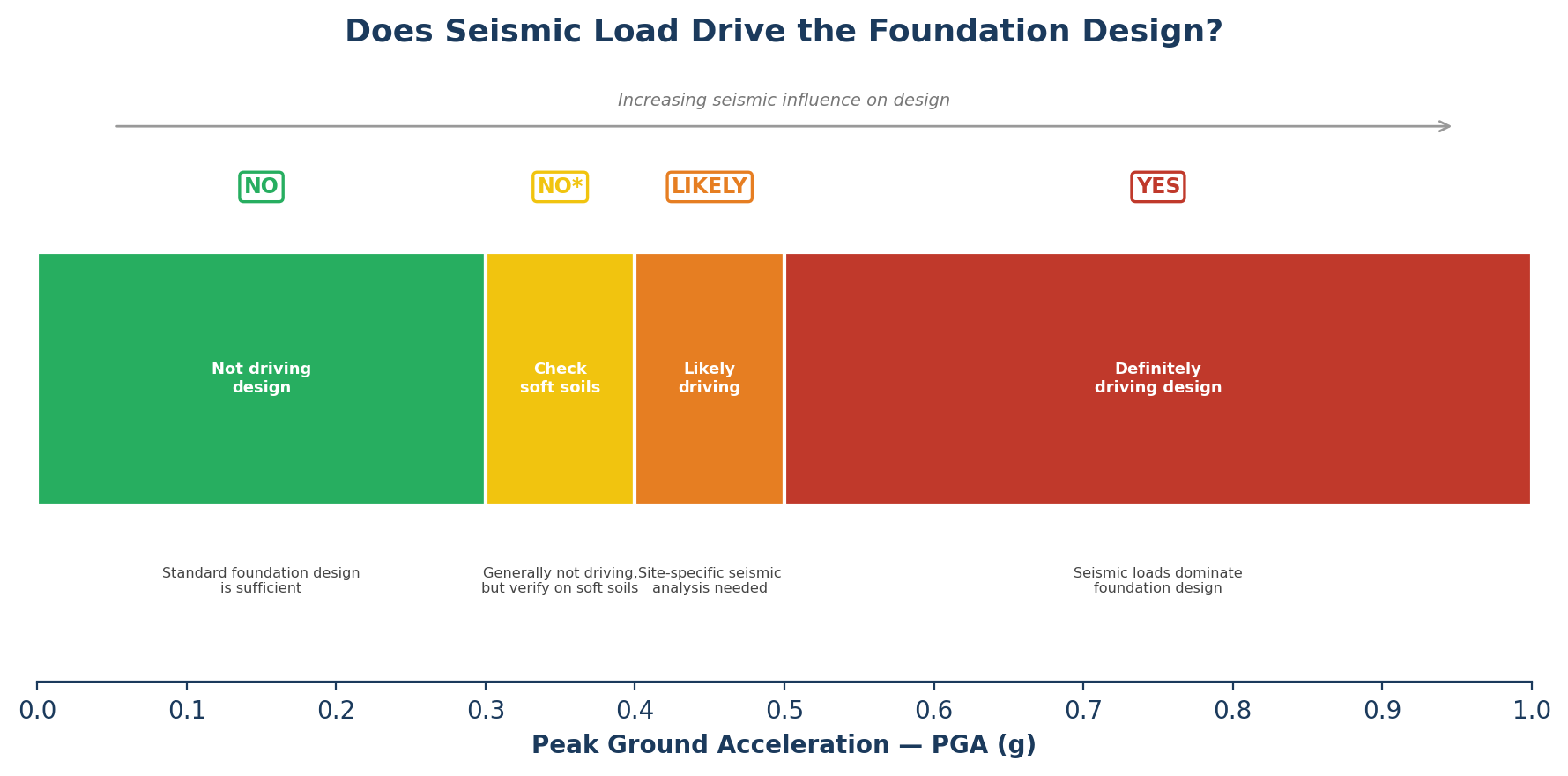
The PGA thresholds that matter
Peak Ground Acceleration (PGA) is the number that tells you, at a glance, whether seismic design will be a headache on your project. It’s expressed as a fraction of gravitational acceleration (g), and it represents the maximum horizontal acceleration the ground surface experiences during a design earthquake.
What are the practical thresholds?
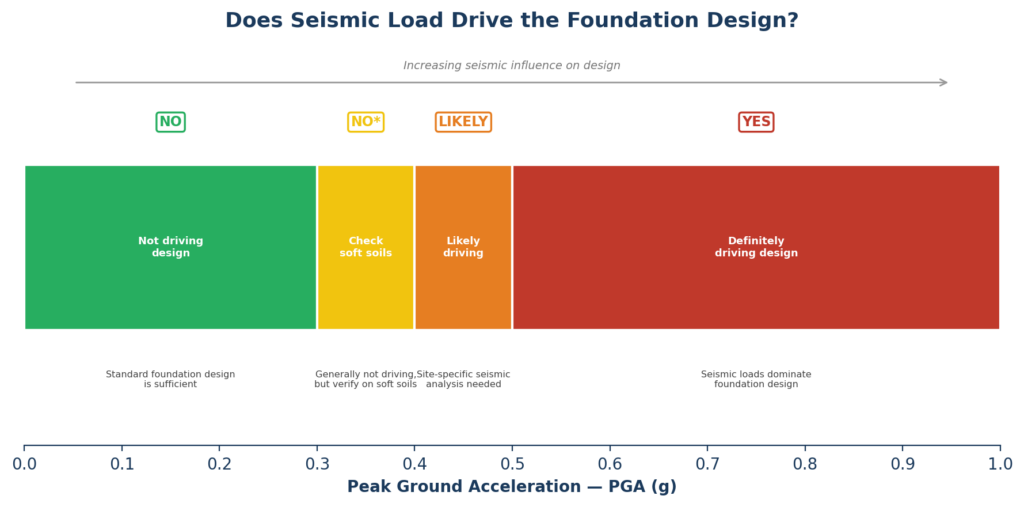
Below 0.30g, seismic loads are not design-driving — the wind loads govern everything, and the earthquake is just a check that passes without changing anything. Between 0.30g and 0.40g, seismic loads are generally still not driving, though you start paying closer attention and running the combinations more carefully. Between 0.40g and 0.50g, seismic loads are likely driving — this is where you start seeing real changes in foundation geometry, reinforcement, or even tower selection. Above 0.50g, seismic loads are definitely driving, and the entire structural design needs to be built around them from the start.
These thresholds are not in any standard — they come from running the numbers on real projects and seeing what comes out. A project in southern Turkey at 0.35g might still be wind-governed, while a site in central Mexico at 0.45g will almost certainly require seismic-specific design modifications.
Understanding the response spectrum
When seismic loads do matter, you need the elastic response spectrum — the tool that converts a raw PGA value into actual forces on your structure. In Europe and most international projects, we follow Eurocode 8 (EN 1998), which defines the spectrum shape based on two inputs: the soil type and the spectrum type.
EC8 classifies soils into types A through E, where A is rock and E is soft alluvial deposits. The soil type dramatically amplifies (or doesn’t) the ground motion. A PGA of 0.35g on rock might be manageable, but the same 0.35g on soft soil type D or E can push accelerations at certain periods much higher — and wind turbine towers, with natural frequencies typically between 0.25 and 0.35 Hz, sit right in the range where soil amplification hurts.
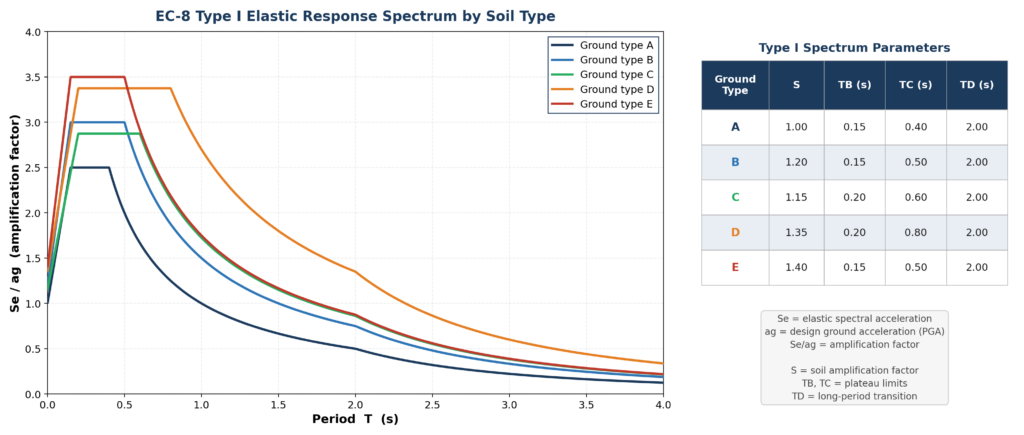
There are two spectrum types in EC8: Type I for general seismicity and Type II for regions where the controlling earthquakes have surface wave magnitudes of 5.0 or less. Type II spectra are more compact — they carry less energy at longer periods — so the distinction matters for tall, flexible structures like wind turbine towers. Getting this classification wrong can mean over-designing (or under-designing) by a significant margin.
The behaviour factor: why wind turbines get no ductility credit
Here’s something that surprises engineers coming from the building world. In conventional structural design, you can reduce your seismic design forces by applying a behaviour factor q, which accounts for the structure’s ability to dissipate energy through plastic deformation. A well-detailed reinforced concrete frame might use q = 3 or 4, meaning you design for forces three or four times smaller than the elastic demand.
Wind turbine towers get essentially none of this benefit. The governing failure mode for a steel tubular tower is shell buckling — and buckling is a fragile, sudden failure mechanism with no energy dissipation. There’s no ductile yielding, no plastic hinge forming gradually while you redistribute loads. The tower buckles, and that’s it. So the behaviour factor for a wind turbine tower is q = 1.0, or very close to it. You design for the full elastic seismic forces with no reduction.
This is one of the key reasons seismic design for wind turbines is more conservative than newcomers expect. In the building world, you learn to count on ductility. In our world, you can’t. (I’ve seen more than one structural engineer from the building sector get this wrong on their first wind project, proposing q = 1.5 or even 2.0 — those submissions get sent back immediately.)
Load combinations: when earthquake meets operation
The IEC 61400-1 standard defines specific Design Load Cases (DLC) for seismic events. The critical ones are DLC 9.5, where the earthquake occurs during normal power production; DLC 9.6, earthquake combined with an emergency shutdown triggered by the shaking; and DLC 9.7, earthquake while the turbine is parked after a grid loss. Each of these combines the seismic demand with a different operational state of the turbine — different rotor speeds, different blade pitch angles, different aerodynamic loads.
In practice, the OEM rarely provides separate load tables for every seismic combination. A common and reasonably conservative approximation is to combine the seismic response spectrum with the peak operational loads from DLC 1.1 (normal power production under extreme turbulence). It’s not exact, but it captures the essential physics: the earthquake hits while the turbine is running and producing its maximum operational loads.
One simplification that EN 1998-6 allows (and that saves a fair amount of calculation time): for towers and chimneys, you can disregard the vertical seismic component entirely. And when combining the two horizontal components, the SRSS rule gives you a factor of the square root of 1 squared plus 0.30 squared, which works out to just 1.044 — barely more than one. So the directional combination is almost negligible.
What changes in the foundation design
When seismic loads are driving, the most visible impact is on the foundation safety factors. Under normal wind loading, a typical gravity foundation is designed with a bearing capacity safety factor of 2.6, a sliding safety factor of 1.50, and an overturning safety factor of 1.80. Under seismic combinations, these are relaxed significantly: bearing capacity drops to 2.2, sliding to 1.22, and overturning to 1.50.
The gap criteria — how much of the foundation base can lift off the soil under extreme overturning — also change under seismic loading. Under normal conditions, most codes require the full base to remain in compression (or at most allow a small uplift zone). Under seismic loading, the rules become more generous: I’ve worked on projects in Mexico where 40% of the base width was allowed to be in compression, and in Chile where the limits were 80% for soil foundations and 60% for rock. (These differences between national codes are one of the reasons you can’t just copy a foundation design from one country to another, even if the turbine and the PGA are identical.)
There’s also the question of liquefaction. In seismically active areas with sandy soils and high water tables, a liquefaction risk analysis becomes mandatory. On a project in Mexico, the geotechnical investigation specifically had to demonstrate that the foundation soils would not liquefy under the design earthquake — and that analysis added several weeks and a significant cost to the geotechnical campaign.
The practical takeaway
If you’re starting a BoP design and the site has a PGA below 0.30g, you can be reasonably confident that seismic loads won’t change your foundation design. Run the checks, document the results, and move on. If the PGA is between 0.30g and 0.50g, allocate time and budget for a proper seismic analysis — you might get lucky, but you might not. And if the PGA exceeds 0.50g, plan for it from day one: the foundation geometry, the reinforcement, and possibly even the tower selection will be influenced by the earthquake.
The most common mistake I’ve seen is treating seismic design as a simple yes-or-no question. It’s not. It’s a spectrum (pun intended) — and where your project falls on that spectrum depends on the PGA, the soil type, the tower height, and the specific national code you’re working under. Get the inputs right, understand that your tower has no ductility credit, and the rest follows from the engineering.
Leave a Reply