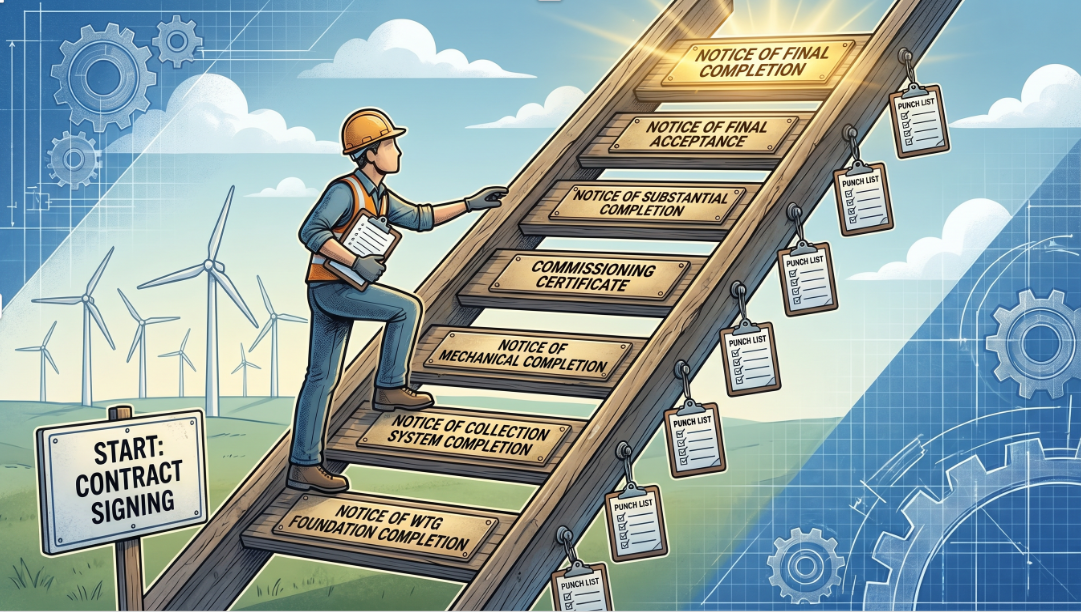
What happens if the contractor wants out and the owner doesn’t want to sign? A painful interface in the BoP lifecycle.
Taking Over (sometimes called Provisional Acceptance, Takeover, Take Over or Substantial Completion) is the milestone where risk, custody, and responsibility shift from the contractor to the owner. In EPC contracts it also unlocks a big chunk of the payment schedule, triggers the Defects Liability Period, and converts construction insurance into operating insurance.
In theory it is a single signature. In practice it is three separate fights that all happen at once: a fight about documents, a fight about punch items, and a fight about the day the clock starts ticking.
Let see those three fights the way you could them, because the contract language, the binders, and the minutes all hide the same basic structure underneath.
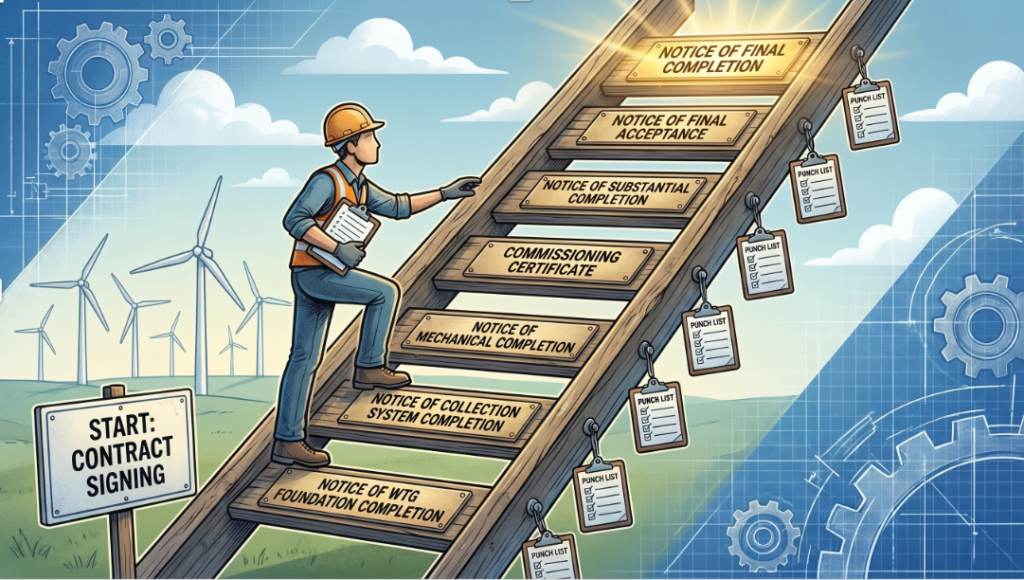
The completion ladder
Before anything else, it helps to understand that in a modern wind farm EPC you do not reach Taking Over in one step. You reach it by climbing a ladder of notices, each one pinned to a punch list. On a Caribbean project the contract defined six distinct certificates, each issued as a separate formal document:
- Notice of WTG Foundation Completion — issued per turbine, once the concrete has cured, the embedment inserts are verified, and the backfill compaction tests are binder-ready
- Notice of Collection System Completion — the MV network is installed and tested end to end
- Notice of Mechanical Completion — the turbine is physically assembled, bolts torqued, walkdown checklist signed
- Commissioning Certificate — issued per WTG after the commissioning protocols are run
- Notice of Substantial Completion — the substation and all WTGs have successfully passed the Acceptance Test
- Notice of Final Acceptance — all WTGs have achieved Substantial Completion, O&M manuals and spare parts have been delivered, and the residual punch list has an agreed monetary value
- Notice of Final Completion — every punch item has actually been closed
FIDIC contracts use different names (Taking Over Certificate, Performance Certificate) and lump some of these together, but the logic is the same: every step of the ladder is a fresh certificate, a fresh punch list, and a fresh opportunity for the owner to say not yet. If you only negotiate the top of the ladder you will lose every disagreement about what “complete” means on the rungs below.
The Documents
The as-built documentation list for a wind farm in the Middle East counted seven tabs, each one for a discipline — WTG docs, WTG energization, roads and crane pads, BoP-electrical, substation and warehouse drawings, substation and warehouse documents, foundations.
A single tab (BoP-electrical) had 600+ rows.
The WTG docs tab alone listed start-up procedures, switchgear commissioning reports, switchgear settings, condition monitoring commissioning, hydraulic and gear oil sample reports, generator alignment reports, SIFs for turbine installation, elevator commissioning, fire detection commissioning.
And that was before you got to the roads tab, which referenced 62 as-built drawing pages just for cluster number 1. The per-turbine binder exceeded five kilograms of paper, and each one needed a hard copy after Taking Over plus a soft copy before.
The industry calls it a “documentation folder.” It is not a folder. It is a logistics operation.
What goes wrong is almost never the existence of the documents. It is the version control and the cross-referencing. The punch list says the ping test on foundation bolts was done on WTG 17 — fine, but the record is in a folder titled Preliminary Punch List WTG03 because someone cloned the template and forgot to rename.
The switchgear commissioning report says ABB SWG Commissioning Report_WTG #2-4-5-6-7_rev2 and there is no rev1 in the binder.
The compaction test certificate exists but the date is two days before the concrete pour, which is physically impossible.
Every one of these findings could be a “valid” reason for the owner to withhold the certificate, and every one of them is trivial to fix if you caught it three months earlier.
Rule of thumb: half of the pain at Taking Over is documentation that was never organised. The other half is documentation that was wrong because nobody was tracking it.
The Dispute
The battleground is usually the punch list.
On the Middle East project the owner’s engineer issued one preliminary punch list per turbine, with fields for Issue ID, description, severity (minor/major/critical), category (Quality, Safety, Documentation, Functional), opened date, opened by, due date, closed date, closed by.
A typical turbine had twenty to fifty open items at preliminary stage. Things like Medical kit does not have an expiration date, air filter is very dirty, it should be changed, HV cable is not installed properly. Mixed severity, mixed credibility.
The dispute is almost always the same three-way tension.
The contractor wants the list declared minor so that Substantial Completion can be certified with an agreed monetary retention (with something like “All of the Work has been completed except for Punchlist items with an aggregate value of $______”).
The owner wants the list declared major so that the certificate is withheld until closure.
The OEM service team, who will inherit the open items on day one of the warranty, wants the list expanded so that construction closes things before service even takes the keys.
Three parties, three incentives, one spreadsheet. I have never seen this resolved without at least one senior meeting, and usually two.
The Day
The Taking Over meeting itself is almost anticlimactic by the time it happens.
The Hand Over document from Sales to Construction had already been signed two years earlier and was already in dispute, becasue the construction team had inherited assumptions about permits, geotech, and layout that turned out to be wrong, and the minutes from that earlier handover were cited like scripture in every subsequent change order.
The Taking Over minutes follow the same pattern.
You record who was present, which certificates were signed, which punch items were carried over to the DLP, which ones were closed as waived, and which documents were still outstanding but accepted subject to delivery within 30 days.
The list of outstanding but accepted subject to delivery is the bit that always haunts the O&M team. Once the contractor is gone, chasing a missing torque record for a transformer that is already energised is somebody else’s problem — and that somebody is usually the asset manager reading this blog.
The single most useful thing I’ve done on projects where I was representing the owner is to bring a draft of the Taking Over minutes to the meeting, pre-filled, with every deferred item already listed. It reframes the meeting from should we sign? to what do we add to the list?. It does not eliminate the dispute, but it moves the centre of gravity in the right direction.
One honest closing thought
Taking Over is the interface where every earlier shortcut comes back. Missing as-built drawings, loose quality records, ambiguous contract thresholds — all of them become visible at this single moment, because it is the first moment in the project when two different parties have to agree, in writing, that the work is done. If you want a painless handover, the work doesn’t start at Taking Over. It starts the day the first foundation is poured, with a documentation tracker that nobody lets out of their sight.
Leave a Reply