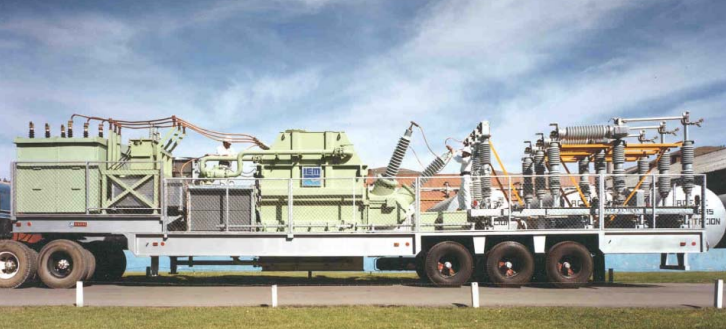
A mobile substation is exactly what it sounds like: a full medium-voltage or high-voltage substation mounted on a trailer.
You have HV disconnector, HV arresters, protection fuses, a power transformer with on-load tap changer, an LV breaker, control cabinet, relays, metering: basically the whole stack compressed onto a single flatbed that a tractor can tow down a road.
The unit arrives on site, and you can unfold the telescopic supports, extend the jacks, connect the HV cables, connect the MV/LV outputs, energise.
Typical ratings I’ve seen in the substation-industry literature are 40 MVA at 115 kV or 138 kV, up to 230 kV units for dense urban zones. Not small.
Mobile substations exist primarily so that distribution companies can keep power flowing when their permanent substations have a catastrophic failure (a transformer burn-out, a busbar fault, a substation fire) or need to be taken offline for planned maintenance.
They are also used to provide temporary capacity during peak load growth in a region that has outgrown its existing infrastructure faster than new permanent plant can be built. And in remote industries (think at oil exploration or mining) mobile substations have served as semi-permanent solutions for years at a time, because moving a truck is cheaper than building a concrete slab, a GIS hall and a steel gantry in the middle of nowhere.
Wind farms are a distant cousin of that remote-industry use case. Most projects will never use one.
But maybe a small fraction of projects could need one, and it is better if you know about mobile substations before the problem appears.
What actually goes on a trailer
A “basic mobile substation” in the manufacturer documentation has three sections arranged along the length of the trailer. At the front, the HV section: the incoming disconnector the HV surge arresters, the HV fuses or circuit breaker, and the high-voltage bushings entering the transformer.
In the middle, the transformer section: a single-phase or three-phase power transformer, either shell-type (tipo acorazado) or core-type (tipo columnas), with an on-load tap changer, and optionally an auxiliary service transformer.
At the rear, the LV section: the low-voltage breaker, the control cabinet with relays and metering, and the LV surge arresters.
The engineering of these units is dominated by three constraints that do not appear in a fixed substation.
Transport height. Road regulations around the world are similar to within a metre: you cannot legally tow anything taller than about 4.5 metres on a public road without special permits, escorts, and sometimes temporary lifting of overhead services. A conventional transformer in a fixed substation has HV bushings pointing straight up. On a mobile unit, those bushings are tilted — sometimes up to 90° from the vertical, i.e. fully horizontal — specifically to get under the height limit. This is not a small design decision. It affects bushing selection, internal insulation clearances, the routing of the HV cable from the bushing into the external connection, and the compatibility of the unit with on-load tap changers.
Vibration and shock. A permanent transformer sits on a concrete pad and does not move for forty years. A mobile transformer is driven down rough roads, parked on uneven ground, relocated several times. The internal supports, the winding clamping, the oil preservation system, the bushing mounts all need to be built for that. Manufacturers prefer composite bushings (silicone rubber over a fibre core) rather than porcelain, because porcelain chips and cracks under transport shock. The deck I was reading as I drafted this is explicit about it: composite insulation is “the most recommended option due to operating conditions.”
Alignment and levelling. Once on site, a mobile substation has to be levelled before it can be energised. The threshold I’ve seen specified is less than 5° of inclination on the platform for energisation. During transport the unit can tolerate up to 20° without risk to the internals. In between those two numbers sits a zone where the unit is physically safe but electrically not energisable — which matters because the “hardstand” for a mobile substation is not a luxury concrete pad; it is a graded compacted gravel area, and getting it flat enough is a bigger job than people expect.
Where a wind farm actually needs one
Let’ see when a mobile substations could (at least in theory) genuinely solve a problem:
The permanent substation is late and the turbines are ready. The BoP schedule has the collector substation and the step-up transformer finishing a few months months before first energisation of the turbines. When the substation slips, with a delayed transformer delivery being the single biggest culprit, the WTGs finish, the cables are pulled, and the commissioning team is on site with nothing to commission.
If you can find a mobile substation with a matching MV/HV step-up ratio you could energise a first batch of turbines, complete acceptance tests, and start earning revenue while the permanent plant is being finished. Renting a mobile unit is almost always cheaper than three months of project idle cost.
Catastrophic failure. Very rare, but real. A transformer in a permanent wind farm substation fails outside warranty. Replacement has a 12+ month lead time. A mobile substation rented from a local utility (or, in a few countries, from a specialist rental company) could bridge the gap. The O&M contract almost never covers this scenario explicitly; it becomes a negotiation between the asset owner, the insurance and the utility.
The case that does not work. Mobile substations are not a substitute for a permanent collector substation. They are tipically smaller, and you would need two or three mobile units running in parallel.
Additionally the control integration, the protection coordination, the earthing philosophy, and the reliability of the combined system all become significantly more complicated than a single well-designed fixed substation.
Closing thought
Mobile substations are an edge case, not a mainstream BoP tool. Most wind projects will never touch one. But the value of knowing they exist is that when the permanent substation schedule slips or a transformer fails unexpectedly, you have a mental model ready.
The owner asks what are our options? and instead of blank faces at the table, someone can say: We could bring in a mobile unit for a few months. Here is who we call, here is what it costs, here is what it can and cannot do.
Leave a Reply